
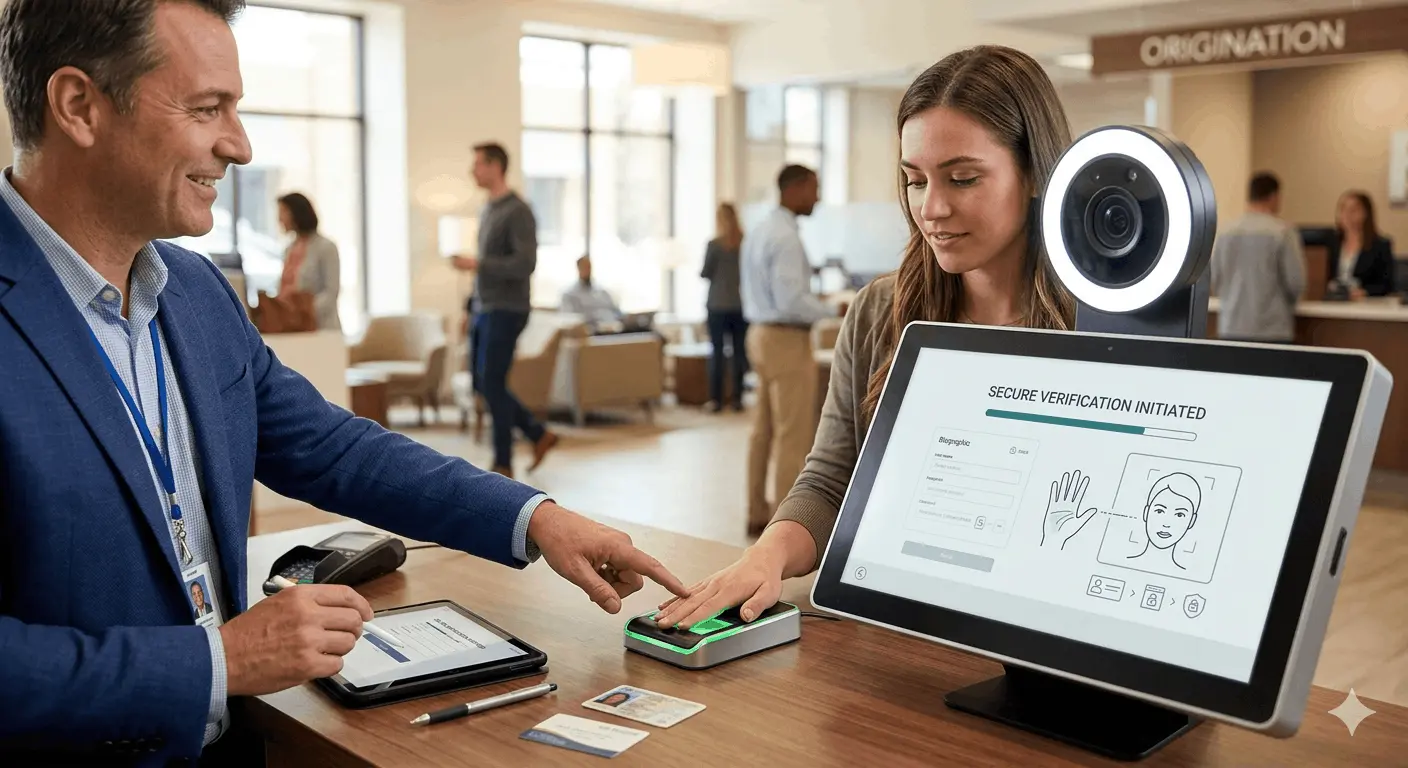
Automating identity verification using biometrics is one way to speed up your credit decisions and streamline customer onboarding.
The Reality of Customer Origination
Many businesses, including financial institutions, telcos, utilities, lawyers, accountants, and trade credit providers, operate in a transactional environment that requires fast credit decisions and onboarding journeys. However, a variety of obstacles prevent them from quickly accessing the data needed to make confident lending or credit decisions.
- Credit applications are typically lengthy, complex and difficult to read as many times it is filled out by hand
- Collecting essential due diligence information such as income and expense, asset, credit and registry data from multiple disparate sources
- Complex calculation and workflows manually completed
- If you’re a business that gets hundreds or thousands of credit applications, the decisioning process is highly resource intensive, as every application takes hours or days of a person’s time
- The identification step in this process itself is very manual, prone to human error and time-consuming
In today’s world of shutdowns and economic uncertainty, it is even more difficult to get reliable insights. But while market conditions have changed, consumer expectations haven’t: consumers still want fast credit decisions. Introducing a biometric solution is a good first step to streamline your entire customer origination process.
Key Steps in Customer Origination and How to Automate at Each Step
Step 1 | Application
The first step in any credit decision process, where the actual application form is created and distributed. This often happens with a printout form, that is filled in by hand.
A modern origination platform does this digitally, via no-code, customisable digital forms, and secure portals where brokers can login and initiate the process.
Step 2 | Data Collection, Decisioning and Verification
This is where multiple data points come together to help make the credit decision. Assessing an applicant’s character, capacity, capital, collateral, and conditions is key to credit approval. Native data integrations and no-code decisioning and scoring engines assist to automate the process.
Other regulatory functions are conducted at this important step such as AML/CFT and affordability checks. Biometric identity verification tools remove the resource intensive manual aspect of AML/CFT customer due diligence by conducting this electronically utilising more data sources, anti-fraud intelligence and biometrics.
Recent changes to the Credit Contracts and Consumer Finance Act (CCCFA) have placed additional regulatory burdens on lenders, amongst others, to assess both the suitability and affordability of the facility sought. Use of digital bank transaction feeds into automated affordability calculators reviewing income and expenditure and trends within that data such as continued unarranged overdraft use or gambling.
Asset checks such as property and vehicle valuations and security checks are conducted and considered when reviewing the facility sought.
Covid-19 has shifted the digital engagement with customers, who are particularly driven by a superior and seamless customer experience. As a result, an omni-channel approach and customer convenience are being prioritised to keep them engaged.
Step 3 | Offer
All data is compiled into a risk profile which is then also rated and matched against pricing and fees. This in turn is formulated into an offer.
If approved, loan documents are generated and sent for execution.
Step 4 | Document Management
Contracts, or loan offers can be created and presented in multiple ways, from automatically sent via email in PDF format for signing and returning via a portal or email to full digital signing. Loan documents are stored against the record and progress the status through to the next stage of funding or disbursement.
Without digital tooling in place, this step would also be highly manual, involving paper trails, physical archives, and manual processing.
Step 5 | Downstream Application and Workflows
Finally, data can also be sent on to other systems via APIs or Webhooks, such as Loan Management, Core Banking or Enterprise Resource Planning Systems, or to load and lodge securities with registries such as the Personal Property Security Register.
Parting Words
Customer origination should never be a pain point for your customers, or your team that needs to process them. With a streamlined customer experience and digital-first platform, you can focus on providing best-in-class service to your customers through faster lending decisions, whilst lowering your risk.
A holistic customer origination platform is highly flexible and can be tailored based on your business’ unique credit policies and workflows. It is natively integrated with numerous databases to perform necessary checks, thus significantly reducing risk, and minimising human errors in the process. Combined with biometric identification to ensure you meet electronic identity verification compliance needs, the customer journey is seamless. Just as any modern customer would expect.
Our Corporate Sponsors